Horsebox Repair
Why GRP Is Replacing Timber in Floors and Ramps
Ask any horsebox repairer what brings most vehicles into the workshop and the answer is usually the floor. Timber floors sit under rubber matting where moisture, bedding and waste are trapped against the boards for years at a time. The rot starts out of sight, and by the time a floor feels soft underfoot the repair has become a full strip-out. Ramps suffer the same way, with the added wear of hooves on the incline every time a horse loads.
Glass reinforced plastic (GRP) offers horsebox repair and refurbishment specialists a different starting point. It does not rot, swell or delaminate in wet conditions, and it is lightweight compared with steel. Engineered Composites has manufactured and supplied GRP products from Chester for 40 years, and our flooring, decking, anti-slip and profile ranges are already used in demanding environments across rail, water and construction. The same properties translate directly to the floors, ramps and fit-out of horseboxes and trailers.
The problem with timber in horsebox floors
Plywood and timber boards remain the default in many trailers and boxes because they are familiar and easy to cut. Their weakness is moisture. Once water gets past the matting it has nowhere to go, and the boards absorb it repeatedly until the fibres break down. Treatments and sealants slow the process but need reapplying, and they rely on the matting being lifted and the floor dried regularly, which rarely happens in day-to-day use.
For the repairer this creates a cycle of like-for-like replacement. A new timber floor goes in, and the same conditions that rotted the old one begin working on the new one immediately. For owners it means recurring cost, time off the road and, if a soft floor goes unnoticed, a genuine welfare concern. Breaking that cycle means changing the material rather than the maintenance schedule.
GRP as a rot-free alternative for horsebox floor repair
GRP is a composite of glass fibre reinforcement in a thermoset resin. Because the resin does not absorb water, a GRP floor is unaffected by the damp conditions that destroy timber. There is no rot, no painting and no sealing required, which is why GRP is specified across wastewater treatment, marine and rail environments where moisture is constant.
Deck500 is the product most relevant to horsebox floors. Each pultruded board is 500mm wide and 40mm deep with a tongue and groove joint, so boards lock together into a continuous surface. The top face is gritted for slip resistance, and the boards are manufactured to BS 4592-4 and BS 4592-5 with material to BS EN 13706 under our ISO 9001 quality system. Wider GRP flooring and anti-slip flooring options are also available where a different format suits the vehicle.
Why loads are confirmed at point of enquiry
Horseboxes and trailers vary widely. A single-horse trailer, a twin-axle trailer, a 3.5 tonne box and an HGV lorry carrying several horses all place different demands on the floor, and the spacing of the supporting chassis members varies too. For that reason we do not publish a single load figure for horsebox use. The team will confirm suitability for each vehicle at point of enquiry, based on the vehicle type, the horses it carries and the support spacing, so the specification is right for that build.
Ramps: grip where it matters most
The ramp is where slip resistance is tested hardest. Horses load and unload on an incline, often in wet or muddy conditions, and a ramp surface that loses grip puts both horse and handler at risk. Timber ramps fitted with battens wear unevenly and the battens themselves rot at the fixings.
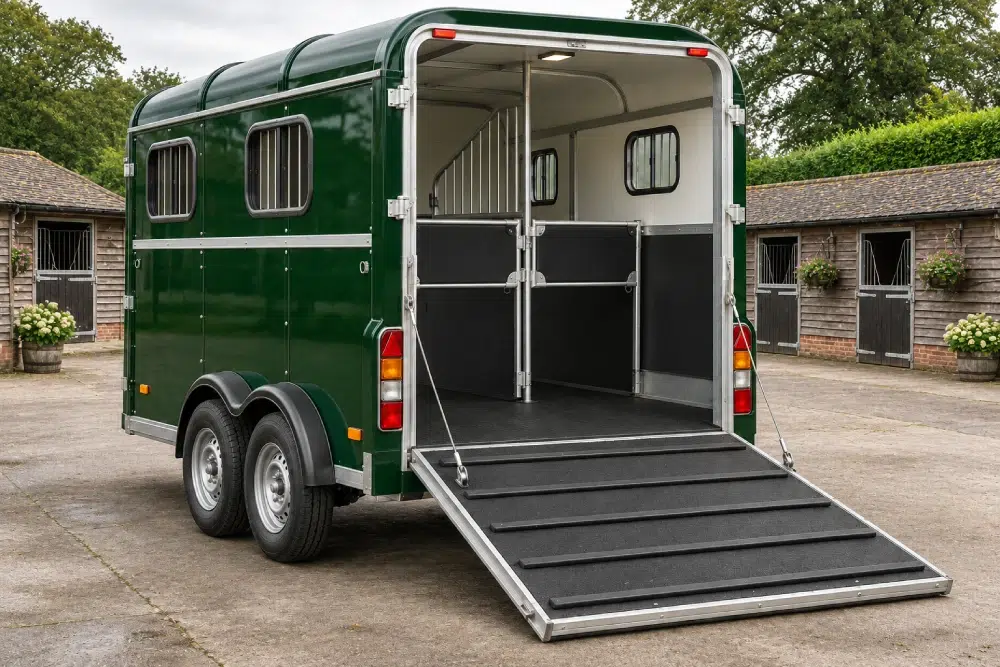
GRP anti-slip decking strips can be fixed across an existing or new ramp to provide a durable gritted surface that does not rot. For steps, tailgates and access points, GRP stair treads and stair nosings give a defined, high-visibility leading edge. Both are lightweight, can be cut and drilled with standard tools, and are a practical upgrade during a ramp refurbishment rather than a specialist fit.
Profiles for battens, trims and fit-out
Beyond the floor and ramp, a horsebox refurbishment usually involves partitions, kick boards, battens and edge trims. Timber and mild steel are common here too, and both suffer in the same damp environment. GRP pultruded profiles including angles, channels, flat sheet and box sections provide corrosion-resistant alternatives that will not rust at fixings or rot at the base. They are non-conductive, maintenance-free and finished in colour throughout, so a cut edge does not expose bare metal that needs painting.
How repairers and builders are using GRP
Consider a repairer stripping out a rotten floor in a twin-axle trailer. Rather than fitting new plywood, they lay Deck500 boards across the existing chassis members after confirming support spacing with our team, then refit the matting. The floor is now unaffected by whatever gets trapped beneath it, and the customer is not back in two years for the same job.
A builder refurbishing a 3.5 tonne horsebox might combine a GRP floor with anti-slip strips on the ramp and GRP angle for the edge trims, giving a fit-out that shares the same rot-free performance throughout. Coachbuilders who construct their own boxes can design GRP in from the start, specifying floor, ramp surface and trims as one package. Stock items are typically delivered within one to two working days across the UK, which helps repairers keep vehicles moving through the workshop.
Conclusion
For horsebox repair and refurbishment, the material choice decides how long the work lasts. GRP removes rot from the equation, reduces ongoing maintenance and gives repairers a durable floor, ramp and trim specification they can offer with confidence. Our horsebox flyer, along with data sheets for the full product range, is available on our downloads page.
Speak to the team at Engineered Composites to find out how GRP can meet your horsebox repair and refurbishment requirements.