GRP Grated Flooring: Technical Insights, Benefits, Material Options and Applications
Grated flooring plays an important role across industrial, commercial and public infrastructure. From manufacturing facilities and water treatment works to railways, marine environments and maintenance platforms, flooring systems must provide a dependable walking surface while coping with demanding environmental and operational conditions.
Modern grated flooring needs to provide more than basic load-bearing capability. Depending on the application, specifiers may also need to consider drainage, slip resistance, chemical resistance, corrosion, electrical conductivity, maintenance requirements and long-term lifecycle costs.
Traditional grated flooring materials include steel, aluminium, timber and concrete. However, advances in composite manufacturing have established Glass Reinforced Plastic, or GRP flooring, as an increasingly important alternative.
GRP combines glass fibre reinforcement with a polymer resin system to create strong, lightweight flooring panels capable of operating in challenging industrial environments.
Engineered Composites supplies GRP flooring and grated flooring solutions for projects across numerous industries, providing options designed around different safety, loading and environmental requirements.
What Is GRP Flooring?
GRP flooring is manufactured from glass fibres embedded within a durable resin matrix. The combination creates a composite material with a particularly useful balance of strength, weight, environmental resistance and durability.
GRP flooring panels can be manufactured in different configurations, including:
- Open mesh flooring
- Mini mesh flooring
- Solid top flooring
- Grit-top anti-slip flooring
- Flooring panels for platforms and walkways
- Stair and landing applications
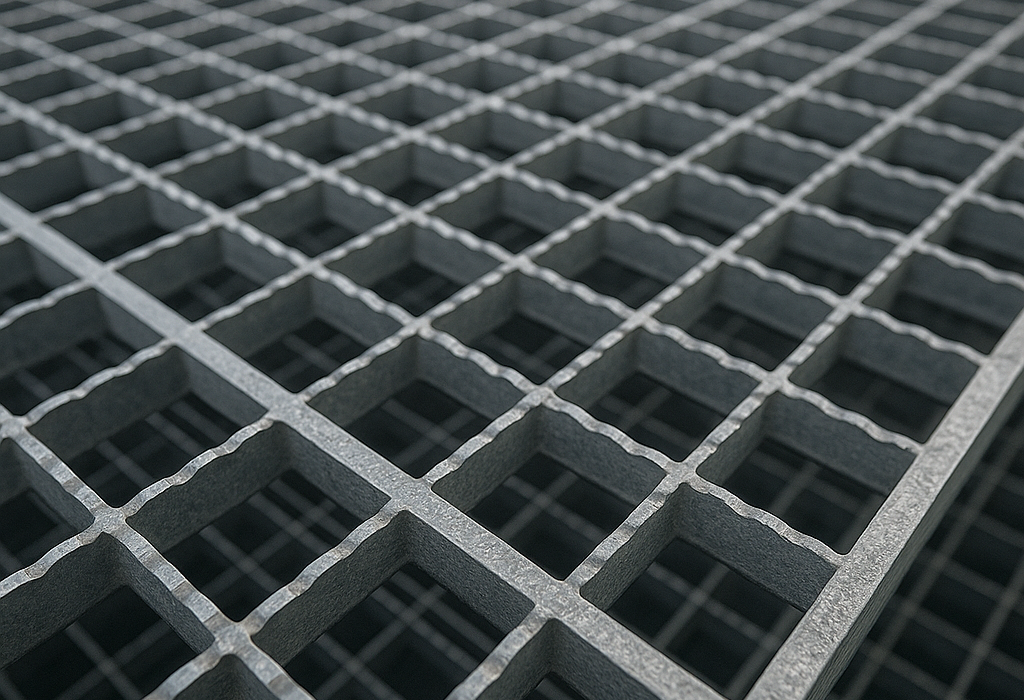
Open grid structures allow water, liquids, dirt and other material to pass through the flooring while providing a stable walking surface.
Solid surface configurations can instead be specified where a continuous floor is required.
These characteristics make GRP flooring suitable for applications including walkways, ramps, platforms, mezzanines, maintenance access areas and environments exposed to water, chemicals or other potential slip hazards.
Why Is GRP Flooring Used in Industrial Environments?
Industrial flooring can experience considerably harsher conditions than flooring installed in ordinary commercial buildings.
Depending on the site, flooring may be exposed to:
- Water and persistent moisture
- Oils and industrial fluids
- Cleaning chemicals
- Acids and alkalis
- Saltwater
- Heavy pedestrian traffic
- Outdoor weather
- Electrical equipment
- Continuous maintenance access
Steel remains appropriate for many heavy-duty applications, but corrosion protection and ongoing maintenance can become important considerations.
Timber may require repeated treatment and is generally less suitable for aggressive wet or chemical environments.
GRP flooring offers an alternative because its composite construction can provide corrosion resistance without relying upon ongoing painting or galvanising.
GRP Flooring Materials Compared
Steel Grated Flooring
Steel is traditionally used in industrial installations requiring substantial load-bearing capacity and impact resistance. Its principal disadvantage in wet, marine and chemically aggressive environments is susceptibility to corrosion. Galvanising, coating or painting may therefore be required depending on the environment.Aluminium Grated Flooring
Aluminium provides a lighter alternative to steel and offers useful corrosion resistance in many environments. However, its mechanical properties differ from steel and GRP, and consideration needs to be given to deflection, surface wear and the specific loads involved.Timber Grated Flooring
Timber may be appropriate for decorative or comparatively light-duty applications. Wet environments, chemical exposure and long-term decay can limit its suitability for demanding industrial applications, particularly where frequent maintenance would be difficult.Concrete Grated Flooring
Precast concrete systems can provide excellent compressive performance and are used in specialist infrastructure applications. Their weight, limited installation flexibility and susceptibility to certain chemical environments can make alternative materials preferable in particular installations.GRP Grated Flooring
GRP combines glass fibre reinforcement with thermosetting resin to provide a lightweight yet durable flooring system. Important advantages can include corrosion resistance, chemical resistance, weather resistance, slip-resistant surfaces and electrical insulation. Where these characteristics are relevant to your project, explore the full GRP flooring range available from Engineered Composites. This internal link follows the consolidation brief, which specifically requires the surviving article to link contextually to the parent flooring category using the anchor “the full GRP flooring range.”Key Advantages of GRP Flooring
Outstanding Slip Resistance
Slip resistance is one of the most important considerations when specifying industrial flooring. Wet weather, oils, processing liquids and other contaminants can significantly increase slip risks. GRP flooring can incorporate a grit surface designed to improve grip underfoot. Open mesh construction can also allow liquids to drain rather than accumulate across the walking surface. These characteristics make GRP particularly relevant for environments such as:- Water treatment facilities
- Food and processing environments
- Marine installations
- Offshore structures
- External access routes
- Industrial platforms
- Areas exposed to frequent spills
Corrosion Resistance
Corrosion is one of the major long-term challenges associated with industrial flooring.
Metal flooring installed around water, chemicals, salt or aggressive atmospheric conditions can require protective coatings and periodic maintenance.
GRP itself does not rust, making it particularly useful in environments involving:
- Wastewater
- Saltwater
- Chemical exposure
- Persistent moisture
- Outdoor weather
- Industrial fumes
This is one reason GRP flooring is frequently considered for marine, chemical processing and water utility applications.
Chemical Resistance
Industrial flooring may also encounter acids, alkalis, solvents, cleaning products and other aggressive substances.
Different resin formulations can be selected according to the application’s chemical environment.
For more demanding chemical installations, appropriate resin selection becomes particularly important during specification.
GRP can therefore provide a practical solution for wastewater facilities, chemical processing sites, industrial manufacturing operations and marine installations.
Lightweight but Structurally Capable
Another important characteristic of GRP flooring is its strength-to-weight relationship.
GRP panels are significantly lighter than equivalent metal alternatives in many applications while remaining capable of supporting substantial design loads when correctly specified.
Lower panel weight can provide several practical advantages:
- Easier transportation
- Simpler handling
- Faster installation
- Reduced manual handling
- Less reliance on heavy lifting equipment
- Reduced dead load on supporting structures
These benefits are particularly valuable for elevated platforms, rooftops, remote installations and refurbishment projects where access may be restricted.
Electrical and Thermal Properties
GRP is electrically non-conductive, making it particularly useful around electrical infrastructure.
Possible applications include:
- Electrical substations
- Rail infrastructure
- Telecommunications facilities
- Power generation environments
- Maintenance platforms near electrical equipment
- Data centres
GRP is also non-magnetic and has relatively low thermal conductivity compared with metallic flooring.
These properties can provide additional benefits where electrical insulation or heat transfer must be considered.
Types of GRP Grated Flooring
The correct flooring configuration depends upon pedestrian use, drainage requirements, loading, safety requirements and the surrounding environment.
Open Mesh GRP Flooring
Open mesh flooring provides an open-grid construction that allows liquids, air and small debris to pass through the walking surface.
It is commonly used for:
- Industrial walkways
- Access platforms
- Water treatment plants
- Marine installations
- Maintenance areas
- External access routes
Its drainage properties make it particularly suitable where standing water needs to be minimised.
Mini Mesh GRP Flooring
Mini mesh flooring uses smaller openings than conventional open mesh grating.
The reduced aperture can provide a more comfortable pedestrian surface while helping to prevent objects from falling through the flooring.
This can make mini mesh useful for:
- Pedestrian walkways
- Public infrastructure
- Access platforms
- Areas accommodating smaller wheeled equipment
- Locations where dropped-object risks need additional consideration
Solid Top GRP Flooring
Solid top GRP flooring provides a continuous walking surface while retaining many of the underlying benefits associated with GRP construction.
It may be selected where:
- Liquids should not pass through the floor
- Objects or debris must not fall to the level below
- A continuous surface is required
- Additional separation between working levels is needed
GRP Stair and Landing Solutions
GRP materials can also be incorporated into stairways and landing areas where consistent corrosion resistance and slip performance are needed throughout an access system.
GRP Flooring Applications Across Different Industries
One of the main reasons GRP flooring is widely specified is its versatility.
Manufacturing and Industrial Facilities
Factories and industrial sites frequently require safe access around machinery, processing equipment and maintenance areas.
GRP flooring can be used for:
- Mezzanines
- Maintenance platforms
- Equipment access
- Elevated walkways
- Processing areas
Its corrosion and chemical resistance can be particularly beneficial where oils, water or industrial substances are present.
Water and Wastewater Treatment
Water treatment installations are among the environments where GRP flooring’s characteristics can be particularly valuable.
These facilities typically combine moisture, chemical exposure and demanding safety requirements.
GRP’s corrosion resistance and anti-slip characteristics make it suitable for walkways, platforms and operational access areas.
Marine and Offshore Applications
Coastal, marine and offshore structures encounter saltwater, moisture and aggressive weather conditions.
Possible GRP applications include:
- Jetties
- Pontoons
- Access walkways
- Offshore platforms
- Maintenance areas
- Coastal infrastructure
Unlike untreated metal, GRP does not rust when exposed to seawater.
Rail and Transport Infrastructure
Transport infrastructure requires materials capable of providing dependable service while limiting maintenance and disruption.
GRP flooring can be employed for trackside access, maintenance routes, platform extensions and infrastructure walkways.
Its electrically non-conductive properties are especially relevant around electrified rail systems.
Chemical Processing Facilities
Chemical facilities can expose flooring to acids, alkalis, solvents and aggressive cleaning substances.
Appropriate GRP resin systems can provide resistance to a wide variety of chemical environments.
Construction
GRP flooring can provide access walkways, elevated work areas and platform systems on construction and infrastructure projects.
Its lightweight nature can simplify installation where access and lifting arrangements are restricted.
Power and Telecommunications
Electrical insulation can make GRP particularly useful in power and telecommunications environments.
Applications may include maintenance access around electrical infrastructure, substations and telecommunications installations.
Public Infrastructure
GRP grated flooring can also be used for bridges, viewing platforms, pedestrian walkways and other outdoor infrastructure.
Slip resistance, weather resistance and low maintenance requirements can all be important advantages for such projects.
Data Centres
Maintenance and rooftop plant areas around electrically sensitive environments can benefit from non-conductive flooring solutions.
GRP can therefore be considered where electrical hazards are an important factor in flooring specification.
Technical Performance of GRP Grated Flooring
The performance of GRP grated flooring depends on several factors, including:
- Glass fibre content
- Resin formulation
- Manufacturing method
- Panel depth
- Mesh configuration
- Support spacing
- Surface treatment
- Loading requirements
Moulded open mesh grating typically uses continuous glass fibres extending in multiple directions through the panel, providing structural strength and resistance to impact.
The appropriate panel specification should always be established against the loads, spans, environment and applicable standards for the individual project.
GRP Flooring Standards and Compliance
Industrial flooring needs to satisfy the technical and safety requirements applicable to its intended installation.
The two existing articles reference standards relating to industrial flooring, pultruded structural profiles, slip testing and fire behaviour.
Important areas that should be considered when specifying GRP flooring include:
- Structural performance
- Permitted loading
- Deflection
- Slip resistance
- Fire performance
- Chemical resistance
- Electrical requirements
- Environmental conditions
Engineers and specifiers should confirm which standards and performance classifications apply to the particular application rather than assuming that a single specification is appropriate for every installation.
GRP Flooring vs Traditional Flooring Materials
For many projects, the choice is not simply about which material has the greatest raw strength.
Whole-life considerations can be equally important.
Feature | GRP Flooring | Steel | Timber |
Slip-resistant options | Yes | Treatment may be required | Treatment may be required |
Corrosion resistant | Yes | Protective treatment normally required | Not applicable to rust, but vulnerable to decay |
Lightweight | Yes | Generally heavier | Relatively light |
Electrical insulation | Yes | No | Varies by condition |
Low routine maintenance | Yes | Often requires coating maintenance | Regular treatment may be needed |
Suitable for wet environments | Yes | Depends on corrosion protection | Limited in demanding environments |
GRP can therefore offer particular lifecycle advantages where corrosion, maintenance and installation weight are major considerations.
Sustainability and Whole-Life Cost
Initial material cost is only one part of industrial flooring expenditure.
Over the life of an installation, organisations may also need to consider:
- Transportation
- Installation
- Coating
- Repainting
- Galvanising
- Corrosion repairs
- Replacement
- Maintenance labour
- Operational downtime
Because GRP does not require the repeated corrosion-protection processes associated with many steel installations, it can reduce maintenance activity during its service life.
Its lower weight may also help reduce transportation and handling requirements.
For infrastructure operators, the ability to reduce maintenance-related access and downtime can be as important as the flooring’s initial purchase price.
Installation of GRP Flooring
GRP flooring panels can typically be cut and prepared using suitable tools and installed onto steel, concrete or GRP supporting structures using appropriate fixing systems.
Because GRP panels are comparatively lightweight, installation may require less lifting equipment than equivalent steel flooring.
This can be particularly useful on:
- Rooftops
- Elevated platforms
- Remote facilities
- Restricted-access projects
- Refurbishments
- Existing structures with loading limitations
The support arrangement, span, fixing type and panel specification should nevertheless be determined according to the engineering requirements of the project.
GRP Flooring Maintenance
One of GRP flooring’s principal benefits is relatively low routine maintenance.
Typical maintenance may involve:
- Periodic inspection
- Removal of accumulated debris
- Cleaning using water or appropriate mild cleaning products
- Inspection of fixings
- Checking for accidental mechanical damage
GRP does not normally require the periodic painting, galvanising or rust treatment associated with steel flooring.
Example GRP Flooring Applications
The existing technical article illustrates how GRP flooring can solve different practical problems across multiple industries.
A coastal installation, for example, can benefit from replacing corrosion-prone metallic flooring with GRP where saltwater exposure and slip resistance are persistent concerns.
At wastewater facilities, GRP flooring can provide a combination of chemical resistance, drainage and secure footing.
Within rail infrastructure, its non-conductive characteristics can provide an additional advantage around electrified areas.
These examples demonstrate why specification should focus on the operational environment rather than evaluating flooring purely on its initial purchase price.
Why Choose GRP Grated Flooring?
Grated flooring is fundamental to safe industrial and infrastructure access.
Steel, aluminium, timber and concrete remain appropriate materials for certain applications, but GRP offers a valuable combination of properties that can make it particularly effective in demanding environments.
These include corrosion resistance, slip-resistant surface options, low maintenance requirements, chemical resistance, electrical insulation and a favourable strength-to-weight ratio.
For water treatment, marine, transport, manufacturing, chemical processing, utilities, public infrastructure and other demanding environments, correctly specified GRP flooring can provide a reliable long-term access solution.
Speak to Engineered Composites About GRP Flooring
Engineered Composites provides GRP flooring solutions for a wide variety of industrial and infrastructure applications.
Whether your project requires open mesh flooring, mini mesh panels, solid top flooring or enhanced slip-resistant surfaces, the appropriate specification should consider load requirements, environment, access conditions and relevant safety standards.
Explore the full GRP flooring range or contact Engineered Composites for technical guidance, product information and support with your flooring requirements.