Fire Resistant GRP – Fire Safety Standards

Glass Reinforced Plastic (GRP), commonly known as fibreglass, is widely recognised for its strength, durability, and versatility across multiple industries. One of its most critical attributes, particularly in sectors where fire safety is paramount, is its fire retardancy. This blog explores the fire-resistant properties of GRP, relevant safety standards, and the advanced solutions provided by Engineered Composites.
Understanding GRP's Fire Retardancy
The fire resistance of GRP primarily depends on the type of resin used in its composition. By incorporating fire-retardant additives into the resin matrix, GRP can withstand high temperatures and prevent flame propagation. The effectiveness of these additives is assessed through standardised fire testing methods to ensure compliance with industry safety requirements.
Key Fire Resistance Standards for GRP
GRP materials undergo rigorous testing to determine their fire performance. Below are some of the most recognised international fire resistance standards:
- BS 476 Part 7 – This British Standard evaluates the surface spread of flame. GRP products can achieve a Class 1 rating, meaning the flame spread does not exceed 165mm within 10 minutes.
- ASTM E84 (Tunnel Test) – This standard measures flame spread and smoke development. Depending on the resin type, GRP can achieve a Class 1 flame spread rating between 5 and 25.
- EN 13501 – A European classification system assessing the reaction to fire for construction materials. GRP gratings can achieve a BFL-S1 classification, indicating limited contribution to fire and low smoke production.
Engineered Composites' Fire-Resistant GRP Products
Engineered Composites offers a range of high-quality GRP solutions designed to meet stringent fire safety standards:
- GRP Fire Retardant Profiles – Manufactured with fire-resistant additives, these profiles are ideal for industries where fire safety is critical.
- GRP Open Mesh Grating – Designed to meet rigorous fire safety standards, these gratings provide flame resistance and minimal smoke production, making them suitable for workplace safety applications.
- GRP Handrail Systems – These handrails comply with BS4592:0 2006+A1 2012, ensuring adherence to strict fire safety regulations for industrial flooring, stairs, and railings.
Applications of Fire-Resistant GRP
GRP gratings and panels are used in chemical plants and refineries, providing structural strength and fire protection.
In marine settings, GRP is utilised for decking and handrails, offering durability and flame resistance.
- GRP enclosures protect sensitive electrical equipment, benefiting from non-conductive and flame-resistant properties.
GRP’s fire retardancy, determined by resin composition and adherence to global safety standards, makes it a trusted material in industries where fire safety is a priority. With its ability to achieve stringent fire ratings while maintaining structural integrity, GRP is an invaluable solution for various applications. Engineered Composites continues to provide innovative GRP products that exceed fire safety standards, ensuring optimal safety and performance in demanding industries.
FAQs About Fire-Resistant GRP
GRP’s fire resistance is enhanced by using specialised resins with fire-retardant additives that prevent flame spread and reduce smoke production.
GRP meets various international fire safety standards, including BS 476 Part 7, ASTM E84, and EN 13501, ensuring its suitability for high-risk environments.
Fire-resistant GRP is commonly used in industrial facilities, marine environments, and electrical enclosures to provide enhanced safety and durability.
Unlike metal, which can conduct heat and corrode, GRP is non-conductive, lightweight, and corrosion-resistant, making it a safer and longer-lasting alternative.
Yes, Engineered Composites offers GRP products tailored to meet specific fire safety requirements for various industries.
Building HS2 Beyond Steel: GRP Structural Profiles, Walkways and Flooring for Long-Life Rail Infrastructure
Introduction HS2 is not being built as a short-term transport...
Read MoreGRP Rebar on HS2: Solving Corrosion, Conductivity and Interference in Critical Rail Environments
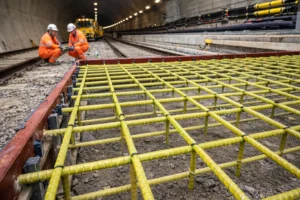
Introduction Reinforced concrete sits at the heart of HS2’s physical...
Read MoreSecuring HS2: Why GRP Palisade and Mesh Fencing Makes Sense for Electrified Rail Infrastructure
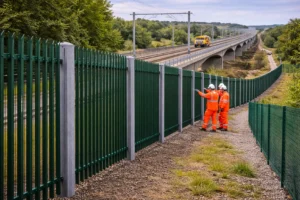
Introduction Few elements of major rail projects are as overlooked...
Read MoreHS2’s Engineering Ambition and the Rise of Composite Solutions in UK Rail Infrastructure
High Speed 2, known simply as HS2, stands as one...
Read More