Non-Metallic Platforms — Preventing Signal Interference in Telecom Installations
Introduction
Telecommunications networks depend on clear, uninterrupted signal transmission. In high-density switching facilities, rooftop antenna sites, and mobile base station compounds, even small levels of electromagnetic interference can reduce network performance. For years, many platform and access systems in telecom environments have been made from steel or aluminium, materials that can reflect, block, or distort signals.
Glass Reinforced Plastic (GRP) offers a non-metallic alternative that prevents these interference issues while delivering durability, safety, and ease of installation in sensitive network environments.
Signal Performance Concerns
One of the primary risks in telecoms installations is electromagnetic interference (EMI) caused by nearby conductive structures. This can reduce signal strength, distort frequencies, and affect coverage areas.
GRP is non-conductive and non-magnetic, meaning it will not interact with radio frequency (RF) signals or create reflective surfaces that distort transmission. This allows antennas and other sensitive equipment to operate at peak efficiency, particularly in dense urban deployments where every decibel of signal clarity matters.
Structural Reliability Without Conductivity
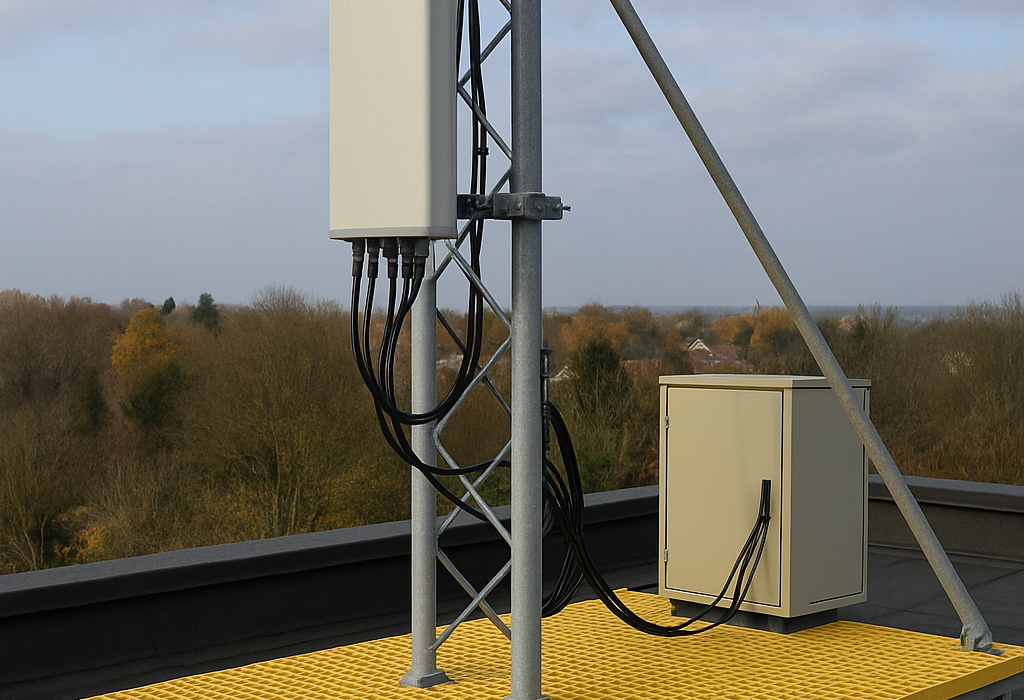
In rooftop and mast installations, operators need strong, load-bearing platforms for maintenance access and equipment support. Traditionally, steel has been used for its strength, but its conductive nature increases the risk of interference and may require additional grounding.
GRP platforms provide equivalent structural strength within telecoms load requirements but without conductivity, eliminating the need for earthing. This simplifies installation and reduces the number of ongoing inspections needed to maintain safety compliance.
Weather Resistance in Exposed Sites
Many telecom installations are in exposed locations such as rooftops, tower tops, or remote ground sites where rain, UV exposure, and temperature extremes are constant. Steel and aluminium can corrode, requiring protective coatings and periodic repainting.
GRP is unaffected by corrosion, UV degradation, or freeze-thaw cycles. Its weather resistance allows it to maintain strength and stability for decades, reducing the need for site visits purely for platform maintenance.
Ease of Installation in Difficult Locations
Accessing a rooftop or elevated mast location with heavy steel components requires cranes, lifting gear, and more personnel, which adds cost and risk.
GRP’s lighter weight allows sections to be manually carried to site and assembled quickly without specialist lifting equipment. This is particularly valuable for rooftop sites where crane access is restricted or impossible due to surrounding buildings.
Safety in Mixed-Voltage Environments
Telecom sites often co-locate with other utilities, including electrical distribution equipment. Metal structures in these environments require bonding to earth to mitigate touch voltage risks.
GRP’s non-conductive composition removes the need for earthing entirely, improving safety during both installation and operation, and reducing the number of work stages required on site.
Long-Term Operational Savings
The total cost of ownership for telecom infrastructure includes both the initial build and the maintenance over its service life. Steel platforms may need recoating every few years and replacement within 20 years in harsh environments.
GRP platforms typically last 50 years or more with minimal maintenance, reducing lifetime platform costs by around 40 percent compared to steel and cutting the number of maintenance visits required.
Conclusion
In telecom installations, preventing signal interference is as critical as structural performance and safety. GRP platforms achieve all three goals by being non-metallic, corrosion-resistant, lightweight, and long-lasting. They provide a future-proof option for network operators looking to improve signal clarity, reduce installation complexity, and lower lifetime maintenance demands.