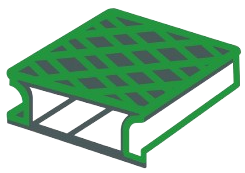
GRP Standards: Handrails & Grating Loading Compliance
When the Barrier Fails, People Fall
Handrails and grating are not glamorous products. They do not feature in architectural magazines or win design awards. But they are among the most safety-critical products on any construction site, industrial platform, or public infrastructure project. When a handrail fails, someone falls. When grating collapses, someone drops through. The consequences are injuries, fatalities, prosecutions, and project shutdowns.
And yet, in our experience across four decades in the GRP industry, handrails and grating are among the most commonly under-specified, under-tested, and over-assumed products in the supply chain. Buyers order ‘a GRP handrail’ without specifying the loading requirement. Designers assume a grating panel is compliant because it looks like one they used before. Contractors install systems without checking whether the test data matches the application.
This guide exists to change that. It sets out the standards, the loading categories, the dimensional requirements, and the questions every buyer and specifier must ask before ordering GRP handrails or grating for any UK project.
1. The Standards: Know Which One Applies to Your Project
Multiple British and European standards govern handrail and barrier design. The standard that applies depends on the application, and getting this wrong at specification stage means the entire installation may be non-compliant.| Standard | Title / Scope | Typical Applications |
| BS 6180:2011 | Barriers in and about buildings — code of practice | Buildings, public areas, transport platforms, stadiums, retail |
| BS 4592-0:2006 +A1:2012 | Industrial flooring, stair treads and handrails — common design requirements | Industrial sites, factories, plant rooms, water treatment works |
| BS EN ISO 14122-3 | Safety of machinery — permanent means of access: guard-rails and handrails | Machinery access, fixed plant, equipment platforms |
| BS EN 1991-1-1 | Eurocode 1 — actions on structures: general actions | All structural design, loading specifications |
| BS 5395-3 | Industrial type stairs, ladders and walkways | Industrial stairs and walkways with handrails |
| WIMES 8.01 | Water industry access platforms, walkways, stairs and ladders | Water and wastewater treatment facilities |
WHICH STANDARD DO YOU NEED?
If your project is a building or public space — BS 6180. If it is an industrial site or plant — BS 4592-0. If it involves machinery access — BS EN ISO 14122-3. If it is a water treatment works — WIMES 8.01 (which references BS 4592 and BS EN ISO 14122). If in doubt, specify BS 6180 as it covers the broadest range of applications and loading categories.
2. Loading Categories: The Number That Determines Everything
The single most important specification decision for any handrail system is the horizontal line load it must resist. This is measured in kilonewtons per metre (kN/m) applied horizontally at the top of the handrail. The required loading depends on the application — and the differences are enormous.
2.1 BS 6180:2011 Loading Categories
| Load (kN/m) | Application Category | Typical Locations |
| 0.36 | Residential — single occupancy, light domestic | Houses, flats, single dwellings |
| 0.74 | Areas not susceptible to overcrowding — light office, industrial sites, external balconies | Offices, factories, industrial platforms, plant rooms, light commercial |
| 1.5 | Areas where crowding may occur — walkways less than 3m wide | Restaurants, retail, public buildings, transport corridors |
| 3.0 | All areas susceptible to overcrowding — walkways greater than 3m wide | Transport platforms (Metrolink, rail), stadiums, concert venues, large public assembly |
2.2 BS 4592-0:2006+A1:2012 Loading Categories
| Load (kN/m) | Duty Classification | Typical Applications |
| 0.36 | Light Duty and General Duty | Standard industrial access, maintenance walkways |
| 0.74 | Heavy Duty | Heavy industrial, process plant, frequent-access platforms |
| 3.0 | Crowd Loading | Public areas, transport platforms |
The critical point: a handrail rated to 0.36 kN/m is not suitable for a transport platform requiring 3.0 kN/m. That is an eightfold difference in loading requirement. A system that comfortably passes at 0.36 kN/m may catastrophically fail at 3.0 kN/m. The application determines the load — not the supplier’s standard offering.
3. Dimensional Requirements: Getting the Geometry Right
Beyond loading, handrail systems must meet specific dimensional requirements. These are not suggestions — they are mandatory compliance criteria.
| Requirement | Dimension | Standard Reference |
| Handrail height (platforms/walkways) | Minimum 1100mm above walking surface | BS 6180, BS EN ISO 14122-3 |
| Handrail height (stairs) | 900–1000mm measured vertically from stair nosing | BS 5395-3, BS EN ISO 14122-3 |
| Mid-rail (knee rail) spacing | Maximum 500mm clear space between any two rails | BS 6180, BS EN ISO 14122-3 |
| Toe plate / kick plate | Minimum 100mm upstand, max 10mm from walking surface | BS 4592-0, BS EN ISO 14122-3 |
| Stanchion centres (maximum) | 1500mm (typically 1000–1250mm for GRP) | BS 4592-0, BS EN ISO 14122-3 |
| Handrail tube diameter | 40–50mm for adequate grip | BS 4592-0 |
| Stair handrail extension | Extend 300mm beyond top and bottom risers | BS 5395-3 |
| Maximum opening (any direction) | 500mm — prevents body passage | BS EN ISO 14122-3 |
Ask your supplier: Does the system as designed meet the dimensional requirements of the applicable standard? Can you provide a general arrangement drawing showing compliance with handrail height, rail spacing, toe plate dimensions, and stanchion centres?
4. Load Testing: The Only Evidence That Matters
A specification sheet is a statement of intent. A load test report is evidence of performance. There is a significant difference between the two, and buyers must understand it.
Many GRP handrail systems are sold with specification sheets that state loading capacities. But a specification sheet is only as good as the testing behind it. The question is not ‘what does the data sheet say?’ — the question is ‘has the system been independently load-tested to the applicable standard, and can you provide the test report?’
4.1 What a Proper Load Test Involves
A comprehensive handrail load test programme should include:
1. Horizontal point load applied at the top rail at mid-span between stanchions
2. Horizontal uniformly distributed load (UDL) along the full length of the top rail
3. Vertical point load at mid-span on the top rail (minimum 1.0 kN)
4. Mid-rail load test (0.5 kN on a 100mm × 100mm area)
5. Deflection measurement at each load increment
6. Permanent deformation check after load removal
7. Connection integrity assessment at all fixing points
The deflection limit under BS 6180 is 25mm at the specified service load. Systems should return to their original position once load is removed, demonstrating elastic behaviour with no permanent deformation.
5. What Our Testing Proves: The ENGI 51mm Box System
In January 2026, we conducted a comprehensive independent load test programme on our new ENGI 51mm Box Section Modular Handrail System at FHB Commercial Standard Testing Laboratory, Burton. The results demonstrate performance that exceeds every comparable steel and GRP handrail system currently on the UK market.
5.1 Test Configuration
| Parameter | Specification |
| Profile | 51mm × 51mm box section, 6.35mm wall thickness |
| Post height | 1100mm above walking surface |
| Post spacing | 1250mm centres (two bays, three posts) |
| EN 13706 grade | E23 — highest performance grade |
| Glass content | Up to 70% by weight |
| Resin system | Isophthalic polyester, fire retardant |
| Testing laboratory | FHB Commercial Standard Testing Lab, Burton |
| Test date | 29th January 2026 |
5.2 Test Results
THREE KEY RESULTS
At 25mm deflection (BS 6180 limit): 1.657 kN/m
At 50mm deflection (Nordic standard): 3.233 kN/m
At 100mm deflection (safety factor test): 7.159 kN/m
Elastic recovery: 100% — zero permanent deformation
5.3 Compliance Against Every UK Standard
| Standard / Application | Required (kN/m) | ENGI Result (kN/m) | Safety Factor | % Exceeded | Status |
| BS 6180 / BS 4592 — Light & General Duty | 0.36 | 1.657 | 4.60x | +360% | PASS |
| BS EN 1991-1-1 — Office Areas | 0.50 | 1.657 | 3.31x | +231% | PASS |
| BS 4592 — Heavy Duty | 0.74 | 1.657 | 2.24x | +124% | PASS |
| BS EN 1991-1-1 — Public Assembly | 1.50 | 1.657 | 1.10x | +10.5% | PASS |
| BS 6180 / BS 4592 — Crowd Loading | 3.00 | 3.233 | 1.08x | +7.8% | PASS |
| Ultimate Capacity — Safety Factor Test | 1.50 (PA) | 7.159 | 4.77x | +377% | PASS |
5.4 What This Means for the Market
The ENGI 51mm Box System is the only GRP handrail system on the UK market to achieve Public Assembly rating (1.5 kN/m) at the BS 6180 deflection limit of 25mm.
Typical GRP round tube handrail systems achieve 0.36 to 0.74 kN/m maximum. Our system delivers 1.657 kN/m — more than double the heavy duty requirement. It also meets Crowd Loading (3.0 kN/m) at the 50mm Nordic deflection standard, opening Scandinavian and European market opportunities.
The 100% elastic recovery is equally significant. At 7.159 kN/m — nearly five times the Public Assembly requirement — the system returned completely to its original position with zero permanent deformation. By contrast, steel handrails undergo permanent plastic deformation at high loads, and typical GRP systems recover 85–95% at best.
6. GRP vs Steel Handrails: The Real Comparison
GRP handrails are frequently compared with steel, and the comparison is overwhelmingly in favour of GRP for the majority of applications.
| Feature | ENGI 51mm Box (GRP) | Typical Steel Handrail |
| Load capacity at 25mm | 1.657 kN/m | 0.74–1.5 kN/m typical |
| Elastic recovery | 100% — zero permanent deformation | Permanent plastic deformation at high loads |
| Corrosion | None — inherently corrosion-free | Requires galvanising and/or painting |
| Weight | Approximately 25% of steel equivalent | Heavy — increases structural loading |
| Electrical safety | Non-conductive — inherent insulator | Conductive — requires earthing |
| Thermal | Warm to touch in all conditions | Cold in winter, hot in direct sun |
| Maintenance (30-year) | None required | Repaint every 7–15 years; £115–£300/m² total protection cost |
| Fire classification | B-s1, d0 (EN 13501-1) | A1 (non-combustible) |
| Design life | 50–100+ years, no maintenance | 30–50 years with continuous maintenance |
Steel’s only advantage is its A1 non-combustible fire classification. For every other parameter — load capacity, elastic recovery, corrosion resistance, weight, electrical safety, maintenance, and lifecycle cost — the ENGI 51mm Box System equals or exceeds steel.
7. The Grating Standards: BS 4592 and WIMES 9.02
GRP grating for industrial and infrastructure applications must comply with BS 4592, the UK standard for industrial flooring. For water industry projects, WIMES 9.02 sets additional requirements.
7.1 BS 4592 Structure
| Part | Scope |
| BS 4592-0:2006 | Common design requirements and recommendations for installation — applies to all grating types |
| BS 4592-4:2006 | GRP open bar gratings — pultruded T-bar or I-bar construction with cross-rods |
| BS 4592-5:2006 | Solid plates in metal and GRP — solid-top grating and plate flooring |
| BS 4592-6:2006 | GRP moulded open mesh gratings and protective barriers |
7.2 WIMES 9.02 — Water Industry Requirements
WIMES 9.02 specifies additional loading requirements for water industry environments. The key requirement is that under a 5 kN/m² uniformly distributed load, grating deflection must not exceed span/200 (0.5% of the span). This is more conservative than many industrial specifications and requires specific verification for each span and grating depth combination.
8. Pultruded vs Moulded Grating: Choose the Right Product
There are two fundamentally different types of GRP grating, and selecting the wrong one for your application can result in structural failure. Buyers must understand the difference.
| Characteristic | Pultruded Grating | Moulded Grating |
| Manufacturing | Individual T/I bearing bars assembled with cross-rods at 150mm centres, secured with epoxy resin | One-piece integrally moulded panel with alternating fibre layers |
| Glass content | 65–70% by weight | 30–40% by weight (higher resin ratio) |
| Strength direction | Unidirectional — significantly stronger in the bearing bar direction | Bi-directional — equal strength in both directions |
| Flexural strength | ~207 MPa | ~172 MPa |
| Stiffness | Twice as stiff as moulded | More flexible, higher impact resistance |
| Span capability | Greater spans at equivalent depths | Shorter spans — requires closer support spacing |
| Best applications | Long spans, heavy loads, structural platforms, industrial flooring | Short spans, chemical environments, areas requiring cutouts, bi-directional loading |
| Osmosis resistance | Good — 55% resin content | Excellent — 65% resin content provides superior moisture barrier |
CRITICAL SPECIFICATION POINT
Pultruded grating MUST be installed with the bearing bars spanning between supports. Installing pultruded grating with bearing bars running parallel to the supports (wrong orientation) will result in dramatically reduced load capacity. Moulded grating, being bi-directional, does not have this constraint. Always verify correct orientation on drawings.
9. Grating Loading and Deflection: The Compliance Test
9.1 What Span/200 Means in Practice
| Span (mm) | Max Deflection (mm) | Span (mm) | Max Deflection (mm) | Span (mm) |
| 600 | 3.0 | 900 | 4.5 | 1200 |
| 6.0 mm for 1200 span |
At 1000mm span, the maximum permissible deflection is 5.0mm. At 1500mm span, it is 7.5mm. The shorter the span, the less deflection is allowed. This is why support beam spacing directly determines which grating depth you need.
9.2 Grating Depth Selection Guide
As a general guide for 5 kN/m² UDL (the WIMES 9.02 standard loading):
| Grating Depth | Maximum Recommended Span | Typical Applications |
| 25mm | 600–800mm — short spans, light access only | Trench covers, small access panels |
| 38mm | 800–1200mm — standard industrial access | General walkways, platform flooring, step treads |
| 50mm | 1200–1500mm — extended spans | Main platforms, vehicle-rated areas, heavy industrial |
| 60mm | 1500mm+ — maximum spans | Large platforms, bridge decking, heavy plant access |
Ask your supplier: For the grating depth you are offering, what is the maximum span at 5 kN/m² UDL that meets span/200 deflection? Can you provide the load/deflection test data to confirm this?
10. Slip Resistance and Surface Finish
Grating for industrial and infrastructure applications must provide adequate slip resistance, particularly in wet, oily, or contaminated environments. GRP grating inherently provides better slip resistance than steel due to its surface texture, and can be further enhanced with:
- Concave top surface: Moulded grating naturally has a concave top surface on each bar, providing grip even when wet.
- Grit coating: Applied to the walking surface for enhanced anti-slip performance. Critical that the grit is properly bonded — the base resin surface must be prepared (gloss removed) before grit application to ensure adhesion.
- Meniscus (crowned) top: Pultruded bearing bars with a crowned surface shed water and provide grip.
QUALITY WARNING: GRIT COATING
We have encountered grating products where the anti-slip grit coating can be rubbed off by hand. This occurs when the manufacturer fails to remove the gloss finish from the GRP surface before applying the grit. Without proper surface preparation, the grit has no mechanical key and will fail in service — rendering the anti-slip properties useless. Always check grit adhesion quality when inspecting delivered goods.
11. GRP Stair Treads: The Dimensional Standards
| Requirement | Dimension | Standard Reference |
| Stair pitch angle | 30–38° preferred (maximum 42°) | BS 5395-3, BS EN ISO 14122-3 |
| Going (tread depth) | Minimum 250mm | BS 5395-3 |
| Rise (step height) | 75–220mm (190mm preferred) | BS 5395-3 |
| 2R + G formula | Between 550mm and 700mm | BS 5395-3 |
| Clear width | Minimum 600mm (800mm preferred) | BS 5395-3, BS EN ISO 14122-3 |
| Maximum risers per flight | 16 risers (then landing required) | BS 5395-3 |
| Anti-slip nosing | Required on all treads | BS 4592-0 |
12. The Buyer’s Checklist: Handrails and Grating
Before placing an order for GRP handrails or grating, confirm the following:
Handrails — 10 Questions
| # | Question | Good Answer | Red Flag |
| 1 | What horizontal line load has the system been tested to? | Specific kN/m stated | ‘Standard loading’ |
| 2 | Can you provide the independent load test report? | Accredited lab report | ‘Data sheet only’ |
| 3 | What deflection was recorded at the specified load? | Specific mm stated | ‘Within limits’ |
| 4 | Was there permanent deformation after load removal? | Zero / measured value | ‘Negligible’ |
| 5 | Does the system height comply with BS 6180 / BS EN ISO 14122-3? | 1100mm confirmed | ‘Adjustable’ |
| 6 | What is the maximum stanchion spacing? | Specific mm stated | ‘Variable’ |
| 7 | Is a mid-rail and toe plate included in the standard system? | Yes, as standard | ‘Optional extra’ |
| 8 | What EN 13706 grade are the profiles? | E23 specified | Not stated |
| 9 | What is the fire classification to EN 13501-1? | Full three-part class | BS 476 only |
| 10 | Is a GA drawing showing dimensional compliance available? | Yes, project-specific | ‘Standard detail’ |
Grating — 10 Questions
| # | Question | Good Answer | Red Flag |
| 1 | Which parts of BS 4592 does the grating comply with? | Specific parts cited | ‘BS 4592 compliant’ |
| 2 | Is it pultruded or moulded? | Clearly stated | ‘GRP grating’ |
| 3 | What is the maximum span at the specified UDL loading? | Span and load stated | ‘Suitable for most spans’ |
| 4 | What is the deflection at the specified span and load? | mm value provided | ‘Within standard’ |
| 5 | Does it meet WIMES 9.02 if for water industry? (5 kN/m², span/200) | Confirmed with data | ‘Should be fine’ |
| 6 | Can you provide load/deflection test data for the specific depth and span? | Test report provided | ‘Available on request’ |
| 7 | What is the fire classification to EN 13501-1? | Bfl-s1 or equivalent | BS 476 only |
| 8 | Is the grit coating properly bonded? (surface prepared before application) | Process confirmed | Unsure / unknown |
| 9 | What is the minimum bearing length at supports? | 40mm minimum stated | ‘Just rests on the beam’ |
| 10 | Has correct orientation been verified on the layout drawing? | Bearing bars perpendicular to supports confirmed | ‘It doesn’t matter’ |
13. The Bottom Line
Handrails and grating are life-safety products. When they fail, people get hurt. The standards exist to prevent that, and compliance with those standards is not optional.
The loading requirements range from 0.36 kN/m for light domestic use to 3.0 kN/m for crowd-loaded transport platforms. The difference between these is not a minor technicality — it is an eightfold increase in the force the system must resist. Specifying the wrong category, or accepting a system without verified load test data, is a decision that carries real consequences.
For grating, the span, depth, product type, and orientation all determine whether the panel will carry the required load within the permitted deflection. A 38mm moulded grating panel at a 1500mm span is not the same product as a 38mm pultruded grating panel at the same span. The strength difference is substantial, and the wrong choice can result in excessive deflection or outright failure.
Demand the load test report. Confirm the loading category. Verify the span and deflection data. Check the orientation. If the supplier cannot provide this information, they are asking you to install a product whose performance is unknown. And in the world of life-safety products, unknown is unacceptable.